Editorial
DOI:
https://doi.org/10.62697/rmiie.v1i3.24Abstract
Estimados lectores:
La pandemia de COVID 19, que durante dos años azotó a la humanidad ha generado cambios sustantivos en todos los sistemas educativos, que requieren de nuevos conocimientos para su transformación.
El cambio principal en el contexto educativo está dado en el paso de un el proceso de enseñanza-aprendizaje presencial a uno on line, a partir de la extensión de las TIC como medio de enseñanza fundamental para todos los niveles educativos. Donde la necesidad de confinamiento en 2020 generó que los hogares se convirtiesen en espacios educativos y las TIC mediaran la interacción didáctica entre docentes estudiantes. Los efectos y el resultado del uso de este medio de enseñanza constituyen una interrogante aún para muchas investigaciones educativas.
De esta forma los efectos sociales, económicos, sanitarios y educativos de la pandemia COVID 19 sirven como punto para futuras investigaciones donde medien las TIC y se analicen las nuevas dificultades en el aprendizaje que trae consigo el uso de estos medios; las competencias digitales de docentes y estudiantes; y las consecuencias emocionales de la falta de interacción social; entre otros temas.
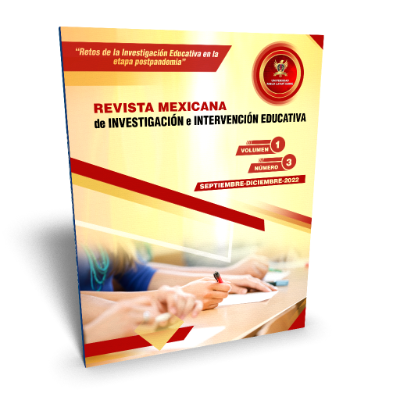
El Consejo Editorial de la Revista Mexicana de Investigación e Intervención Educativa se complace en presentarles el volumen 1, número 3 con contribuciones que se ajustan a los retos de la Investigación Educativa en la etapa postpandemia. A su vez exhorta a los lectores a enviar sus resultados de investigación para futuros números.
Downloads
Downloads
Published
How to Cite
Issue
Section
License
Copyright (c) 2022 Dr. C. Jorge Luis León-González

This work is licensed under a Creative Commons Attribution-NonCommercial-ShareAlike 4.0 International License.
Authors who publish in Revista Mexicana de Investigación e Intervención Educativa (RMIIE), of Universidad Pablo Latapí Sarre agree to the following terms:
1. Copyright
Authors retain unrestricted copyright to their work. Authors grant the journal the right of first publication. To this end, they assign the journal non-exclusive exploitation rights (reproduction, distribution, public communication, and transformation). Authors may enter into additional agreements for the non-exclusive distribution of the version of the work published in the journal, provided that acknowledgment of its initial publication in this journal is given.
© The authors.
2. License
The articles are published in the journal under the Creative Commons Attribution-NonCommercial-ShareAlike 4.0 International License (CC BY-NC-SA 4.0). The terms can be found at: https://creativecommons.org/licenses/by-nc-sa/4.0/deed.en
This license allows:
- Sharing: Copying and redistributing the material in any medium or format.
- Adapting: Remixing, transforming, and building upon the material.
Under the following terms:
- Attribution: You must give appropriate credit, provide a link to the license, and indicate if any changes were made. You may do this in any reasonable manner, but not in any way that suggests the licensor endorses or sponsors your use.
- NonCommercial: You may not use the material for commercial purposes.
- ShareAlike: If you remix, transform, or build upon the material, you must distribute your creation under the same license as the original work.
There are no additional restrictions. You may not apply legal terms or technological measures that legally restrict others from doing anything the license permits.